The Election Commission of Pakistan has announced that independent candidates, a majority of them supported by the PTI secured 101 seats, followed by Pakistan Muslim League-Nawaz (PML-N) with 75 seats, Pakistan Peoples Party (PPP) getting 54 seats, and Muttahida Qaumi Movement-Pakistan (MQM-P) bagging 17 seats.
Bhutto, who served as the Foreign Minister earlier, addressed a briefing at the UN Headquarters in New York and sought reconciliation with India, making a plea for talks and Intel sharing between the two neighbours.

If Patel had lived a few years more, he may or may not have become prime minister. But for sure, his presence would have kept Nehru in check, points out Harishchandra.
'It is typical of China's strategic deception of making virtue out of necessity,' observes Rup Narayan Das.
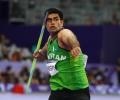
Pakistan's sensational javelin thrower Arshad Nadeem who won the country's first individual Olympics gold in 40 years is being showered with cash awards by Punjab and other provincial governments and organisations.

Hitting back, Congress spokesperson Supriya Shrinate posted a picture of Afridi with BJP leader Anurag Thakur to say that the ruling party should be ashamed for asking questions from the Congress while it itself maintain ties with them.
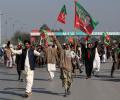
Among the political parties, the Pakistan Muslim League-Nawaz (PML-N) emerged as the largest party, winning 227 seats, followed by the Pakistan Peoples Party (PPP) with 160 seats.
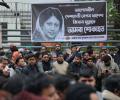
Former Indian envoys reflect on the life and legacy of Bangladesh's former Prime Minister Khaleda Zia, highlighting her role in restoring democracy and the complex relationship between India and Bangladesh during her tenures.

'Kashmir needs to be divided and we need the land of Panun Kashmir in Kashmir.'
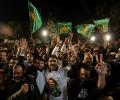
The result is a big blow to the military establishment, revealing the limits of 'political engineering'. It reflected the anger of the electorate, especially its younger voters, who have spoken decisively against the persistent harassment and victimisation of Imran Khan's political party, asserts Rana Banerji, who headed the Pakistan desk at RA&W.
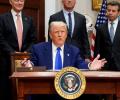
President Donald Trump on Monday claimed that his administration stopped a 'nuclear conflict' between India and Pakistan, adding that he told the two countries America will do a 'lot of trade' with them if they stop the conflict.
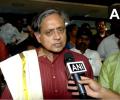
"It is high time India traded dynasty for meritocracy. This would require fundamental reforms, from imposing legally mandated term limits to requiring meaningful internal party elections, together with a concerted effort to educate and empower the electorate to choose leaders based on merit," Tharoor said.

Finance Minister Nirmala Sitharaman criticizes the DMK government in Tamil Nadu, alleging corruption, caste-based crimes, and a rise in drug abuse. She dismisses the DMK's claims about language and Dravidian identity as a distraction from their governance failures.
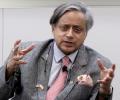
"I'm very glad you raised this, Ishaan. I didn't plant it. I promise you. This guy does this to his dad," Tharoor replied amid laughter from the audience.

The Pakistan Democratic Movement, an alliance of 11 opposition parties formed on September 20, has launched a three-phased anti-government movement under an "action plan" to remove the Khan-led Pakistan Tehreek-e-Insaaf government.
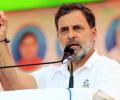
Democracy in India is too important to be left to a leader with a limited appeal. If Rahul Gandhi cares for India, he should step aside for a new crop of leaders, suggests Harishchandra.

Defence Minister Rajnath Singh refuted claims of US President Donald Trump's intervention to halt the Indo-Pak conflict following Operation Sindoor, emphasizing that the action against terrorists was not suspended due to any third-party mediation.

Clearly, her father hopes that a successful tenure in Lahore will give Maryam the ballast to be prime minister after the next general election.
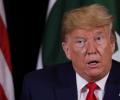
Pakistan's Ambassador to the US, Rizwan Saeed Sheikh, has urged President Donald Trump to help ease tensions with India, highlighting the Kashmir issue as a "flash point" in nuclear terms. He believes that the US should take a more comprehensive and sustained approach to address the situation rather than just immediate de-escalatory measures.
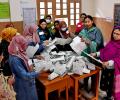
President Alvi recalled the fight for the EVMs waged by the previous PTI-led government, saying that the entire endeavour -- which involved more than 50 meetings at the presidency alone -- was abandoned.
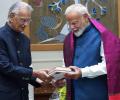
Congress veteran and former Lok Sabha Speaker Shivraj Patil passed away at 90. He served as Union Home Minister and held several key posts during his long political career.
'Outrage will take place sooner than later, because it's not only that their mandate has been stolen, but the most important issue right now is the sinking economy in Pakistan.' 'Inflation is 26%-27%. It is backbreaking inflation.' 'Food, energy, education, health, which are the primary things that every family requires, is going beyond the reach of the masses.'

US President Donald Trump has repeated his claim that Washington got involved with India and Pakistan, saying he didn't like what was happening and that he did a good job as he convinced the two countries to let's have peace and let's go and make trade deals.
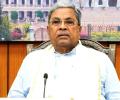
Karnataka Chief Minister Siddaramaiah has clarified his remarks on the Pahalgam terror attack, saying he did not call for no war with Pakistan, but emphasized that war should only be a last resort. His comments, which were played up by Pakistan media, have sparked criticism from the BJP, which accused him of acting like a "puppet" of an enemy nation.
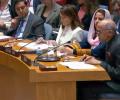
India told the UN Security Council that it calls for a pragmatic engagement with the Taliban, underlining that a focus on only punitive measures will ensure a 'business as usual' approach.
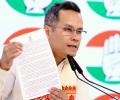
Speaking to reporters at Tezpur, Sarma also said that he would be happy if Gogoi files a case against him for making such a remark.
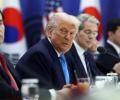
United States President Donald Trump on Wednesday lavished praise on Prime Minister Narendra Modi as the 'nicest-looking guy' while describing him as a 'father' but also calling him 'a killer' and 'tough as hell', while hinting at an imminent trade deal between the two countries.
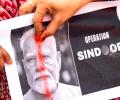
World leaders, including the UN Secretary-General and US President Donald Trump, have urged India and Pakistan to exercise restraint and seek peaceful solutions to the ongoing tensions. The calls for calm come after India conducted airstrikes in Pakistan-occupied Kashmir in response to a recent terrorist attack. Leaders from the US, Russia, UK, China, UAE, Qatar, and Japan have expressed concern over the escalating situation and emphasized the need for dialogue and de-escalation.
'Those who call for war from far-off places should realise the repercussions it has on the people who are actually affected.'
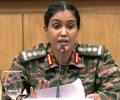
Senior Bharatiya Janata Party leader Mukhtar Abbas Naqvi on Wednesday condemned Madhya Pradesh minister Vijay Shah's controversial remarks about Colonel Sofia Qureshi, a senior Army officer who briefed the media along with Foreign Secretary Vikram Misri and Wing Commander Vyomika Singh during Operation Sindoor.

Pakistan military spokesperson Lieutenant General Ahmad Sharif Chaudhry told a hurriedly called press conference in Islamabad at around 4 am that th Pakistan air force's Nur Khan (Chaklala, Rawalpindi), Murid (Chakwal) and Rafiqui (Shorkot in Jhang district) airbases were targeted.

A BJP MLC in Karnataka, N Ravikumar, has been booked for allegedly making a derogatory remark against the Kalaburagi deputy commissioner, Fouzia Tarannum, calling her a "Pakistani." The comment, made during a BJP protest, has sparked outrage, with the IAS Officer's Association demanding an unconditional apology from Ravikumar. The association described the remark as "baseless, unjustified, and entirely devoid of rationale." An FIR has been registered against the MLC and the matter is under investigation.
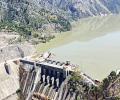
Pakistan has halted the construction of contentious canals in Punjab province after India suspended the Indus Waters Treaty following a deadly terrorist attack in Kashmir. The decision to suspend the canals project was made after Prime Minister Shehbaz Sharif met with PPP chairman Bilawal Bhutto-Zardari and agreed to address the concerns of Sindh province, where the project had sparked protests. The canals project, aimed at irrigating the desert region in Punjab, was seen as a threat to water resources in Sindh. Both sides have agreed to seek consensus on the issue in the Council of Common Interests (CCI), a high-powered inter-provincial body. Meanwhile, Pakistan has reiterated the importance of the Indus Water Treaty for its water security and economy, and condemned India's move to suspend it.
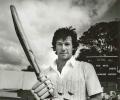
The Imran Khan enclosure, which is one of the VIP stands in the stadium, has been a permanent fixture at the venue since 1992.
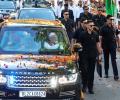
'It is important India to stay focussed on its primary national objectives: Combating terrorism; not losing sight of other security and strategic concerns (on the Sino-Indian front for instance); ensuring a strong economy and registering growth which includes improving the lot of common people; and finally making certain that the social fabric remains intact and harmony among people is not jeopardised, at least any further,' asserts Nilanjan Mukhopadhyay.

AIMIM chief Asaduddin Owaisi slammed Pakistani politician Bilawal Bhutto-Zardari for his "blood would flow in rivers" remark and called former cricketer Shahid Afridi a "joker" for his comment on the Pahalgam terror attack. Owaisi also supported India's decision to suspend the Indus Waters Treaty and called for Pakistan to be placed on the FATF grey list. He also advocated for cyber attacks against Pakistan.
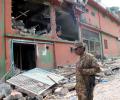
'If destroyed runways and burnt-out hangers look like victory, as the prime minister claimed, Pakistan is welcome to enjoy it.'
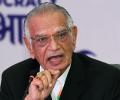
The Congress leader was Union Home Minister from 2004 to 2008 and the 10th Speaker of the Lok Sabha from 1991 to 1996. He was the Governor of Punjab and also served as Administrator of the Union Territory of Chandigarh from 2010 to 2015.

Rane also questioned Uddhav Thackeray's right to comment on the match, accusing his party of staying silent when pro-Pakistan slogans were allegedly raised at a rally by one of its MPs.
The women's wing of the Sena UBT will launch a Sindoor Raksha Abhiyan, a protest campaign where women will take to the streets to express their outrage.
